Querida comunidad de fe, querida familia. Hoy estaremos celebrando nuestra Asamblea Anual. Nos reunimos no solo para evaluar informes, números o decisiones, sino para recordar quiénes somos y por qué existimos. Somos un pueblo llamado por Dios, sostenido por la gracia y enviado al mundo con esperanza, aun en medio de tiempos complejos y cambiantes.
La Asamblea Anual no es simplemente un ejercicio administrativo; es un acto espiritual. Es el momento en que miramos hacia atrás con gratitud, reconocemos el presente con honestidad y miramos hacia el futuro con fe. Damos gracias por lo que se ha sembrado, por quienes han servido con amor —muchas veces en silencio— y por la fidelidad de Dios que no nos ha soltado en ningún momento.
No todo ha sido fácil. Hemos conocido cansancio, incertidumbre y preguntas profundas. Pero hoy afirmamos algo esencial: la Iglesia no se mide solo por lo que tiene, sino por la esperanza que encarna. Y esa esperanza sigue viva entre nosotros y nosotras.
Dios nos ha confiado esta comunidad, este tiempo y este lugar. No para repetir fórmulas del pasado, sino para discernir juntas y juntos lo que el Espíritu está haciendo ahora. Cada voz aquí importa, cada historia cuenta, cada decisión debe nacer del amor, la justicia y el cuidado mutuo.
Que esta asamblea sea un espacio de escucha respetuosa, de diálogo sincero y de visión compartida, que no nos guíe el miedo, sino la fe, que no nos paralice la escasez, sino la creatividad del Evangelio, que no nos divida la diferencia, sino que nos una el propósito común de servir.
Sigamos caminando como comunidad que ora, que aprende, que se equivoca y vuelve a intentar, que abraza y que sueña. Dios aún no ha terminado con nosotros o nosotras. Que el Espíritu Santo nos conceda sabiduría para decidir, valentía para actuar y ternura para cuidarnos en el proceso.
Sermon January 25, 2026 – Annual Assembly
Dear faith community, dear family, today we are celebrating our Annual Assembly. We gather not only to evaluate reports, figures, or decisions, but to remember who we are and why we exist. We are a people called by God, sustained by grace, and sent into the world with hope, even in the midst of complex and changing times.
The Annual Assembly is not simply an administrative exercise; it is a spiritual act. It is the moment when we look back with gratitude, acknowledge the present with honesty, and look toward the future with faith. We give thanks for what has been sown, for those who have served with love—often silently—and for God’s faithfulness, which has never abandoned us.
It has not all been easy. We have experienced weariness, uncertainty, and profound questions. But today we affirm something essential: the Church is not measured only by what it possesses, but by the hope it embodies. And that hope remains alive among us.
God has entrusted us with this community, this time, and this place. Not to repeat past formulas, but to discern together what the Spirit is doing now. Every voice here matters, every story counts, every decision must be born of love, justice, and mutual care.
May this assembly be a space of respectful listening, sincere dialogue, and shared vision, may we be guided not by fear, but by faith, may we not be paralyzed by scarcity, but by the creativity of the Gospel. May differences not divide us, but rather unite us with the common purpose of serving.
Let us continue walking as a community that prays, that learns, that makes mistakes and tries again, that embraces and dreams. God is not yet finished with us. May the Holy Spirit grant us wisdom to decide, courage to act, and tenderness to care for one another along the way.
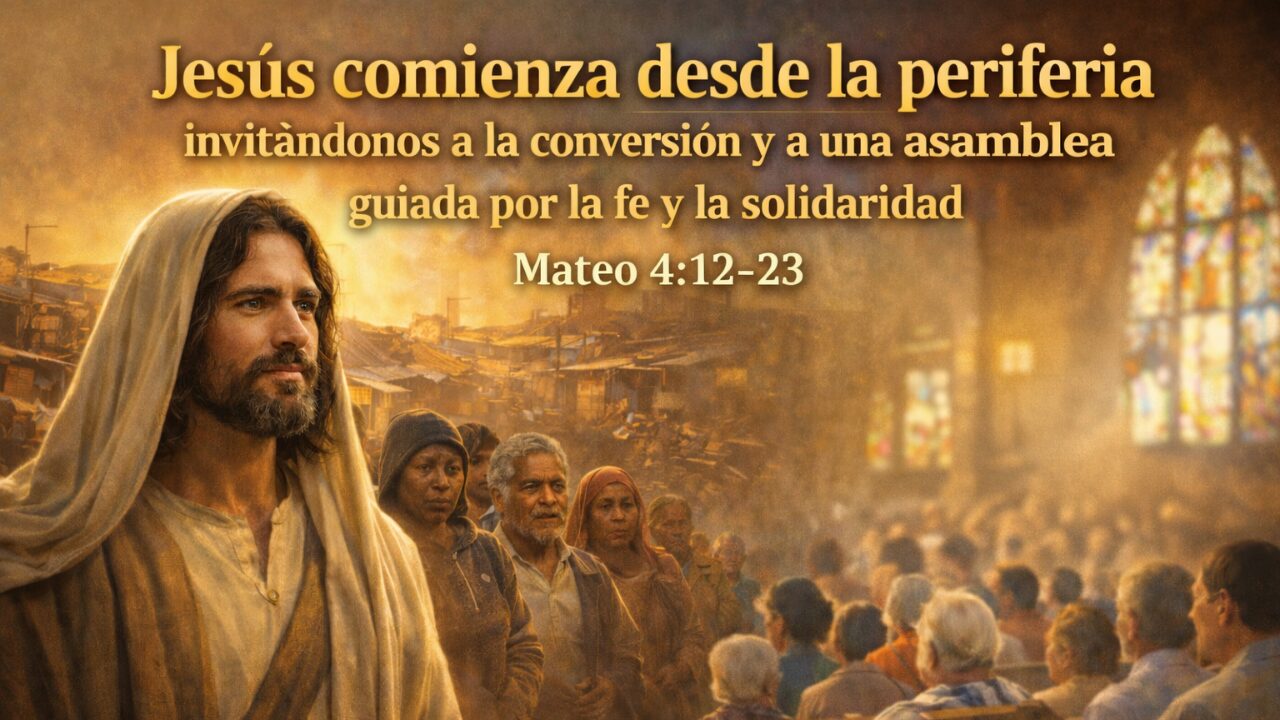
En este contexto, el evangelio de hoy — Evangelio Mateo 4:12–23 — nos coloca en un momento decisivo:
Jesús se mueve. No se queda donde es seguro. Se desplaza hacia Galilea, una región herida por la pobreza, la ocupación imperial y el desprecio religioso. Mateo no lo dice como dato geográfico, sino como confesión teológica: Jesús comienza desde la periferia y esta invitando a la Iglesia a que haga lo mismo.
¿Qué significa «periferia» en términos humanos y sociales?
- Geográfica: barrios olvidados, zonas rurales empobrecidas, islas y comunidades alejadas.
- Económica: personas en pobreza, precariedad laboral, exclusión del acceso a servicios básicos.
- Social y cultural: migrantes, personas racializadas, mujeres invisibilizadas, juventudes sin voz, personas LGBTQ+, personas con discapacidades.
- Política: quienes no influyen en decisiones que afectan sus propias vidas.
- Eclesial: quienes no encajan en los moldes tradicionales de la iglesia o han sido heridos por ella.
La periferia no es solo un lugar físico; es una condición de exclusión.
In this context, today’s Gospel — Matthew 4:12–23 — places us at a decisive moment:
Jesus moves. He doesn’t stay where he is safe. He travels to Galilee, a region wounded by poverty, imperial occupation, and religious contempt. Matthew doesn’t state this as a geographical fact, but as a theological confession: Jesus begins from the periphery and is inviting the Church to do the same.
What does «periphery» mean in human and social terms?
- Geographic: forgotten neighborhoods, needy rural areas, islands, and remote communities.
- Economic: people living in poverty, precarious employment, and exclusion from access to basic services.
- Social and cultural: migrants, racialized people, marginalized women, voiceless youth, LGBTQ+ people, and people with disabilities.
- Political: those who have no influence on decisions that affect their own lives.
- Ecclesial: those who do not fit into the traditional molds of the church or have been hurt by it.
The periphery is not just a physical place; it is a condition of exclusion.
Es por esto por lo que:
1) La luz no nace en el centro:
Mateo cita a Isaías: «El pueblo que habitaba en tinieblas vio una gran luz». Esa luz no irrumpe en palacios ni en templos controlados, sino en caminos, orillas y redes de pesca. La Buena Noticia empieza donde la vida es frágil.
Predicar este texto es recordar que el Reino-Comunidad no se anuncia desde la comodidad, sino desde la solidaridad con quienes cargan sombras reales: hambre, miedo, exclusión, cansancio.
2) Convertirse no es huir del mundo
Jesús proclama: «Conviértanse, porque el Reino-Comunidad de los cielos se ha acercado». Conversión aquí no es culpa ni escape espiritual; es cambio de dirección, giro del corazón y del proyecto de vida. Convertirse es desaprender los valores del imperio —competencia, acumulación, indiferencia— y aprender la lógica del Reino-Comunidad: cuidado, justicia, comunidad.
Hoy, Cristo sigue caminando por nuestras Galileas: barrios olvidados, familias cansadas, juventudes sin futuro claro, pueblos que resisten. Y vuelve a decirnos:
«Síganme» —no mañana, no cuando todo esté resuelto— ahora, en medio de la vida real.
Hermanas y hermanos, confiamos que hoy tengamos el valor de soltar las redes que nos atan y la fe suficiente para caminar tras la Luz que ya ha comenzado a brillar. Salgamos como Jesús a la periferia y así Todos los Santos y Santas cumplirá su compromiso de compartir las Buenas Nuevas. Amén y Ashe.
This is why:
1) The light does not originate in the center:
Matthew quotes Isaiah: «The people who walked in darkness have seen a great light.» This light does not surge forth in palaces or controlled temples, but on roads, riverbanks, and fishing nets. The Good News begins where life is fragile.
Preaching this text means remembering that the Kingdom-Community is not proclaimed from a place of comfort, but from solidarity with those who bear real shadows: hunger, fear, exclusion, weariness.
2) Conversion does not escape the world.
Jesus proclaims: «Repent, for the Kingdom-Community of heaven has come near.» Conversion here is not guilt or spiritual escape; it is a change of direction, a turning of the heart and of one’s life project. Conversion is unlearning the values of the empire—competition, accumulation, indifference—and learning the logic of the Kingdom-Community: care, justice, community.
Today, Christ continues walking through our Galilee: forgotten neighborhoods, weary families, youth without a clear future, communities that resist. And He tells us again:
«Follow me»—not tomorrow, not when everything is settled—now, in the midst of real life.
Brothers and sisters, we trust that today we will have the courage to cast off the nets that bind us and the faith to walk after the Light that has already begun to shine. Let us go out like Jesus to the peripheries, and thus All Saints will fulfill their commitment to share the Good News. Amen and Ashe.
Puedes leer todos los sermones del Padre Luis Barrios en la sección de Sermones.