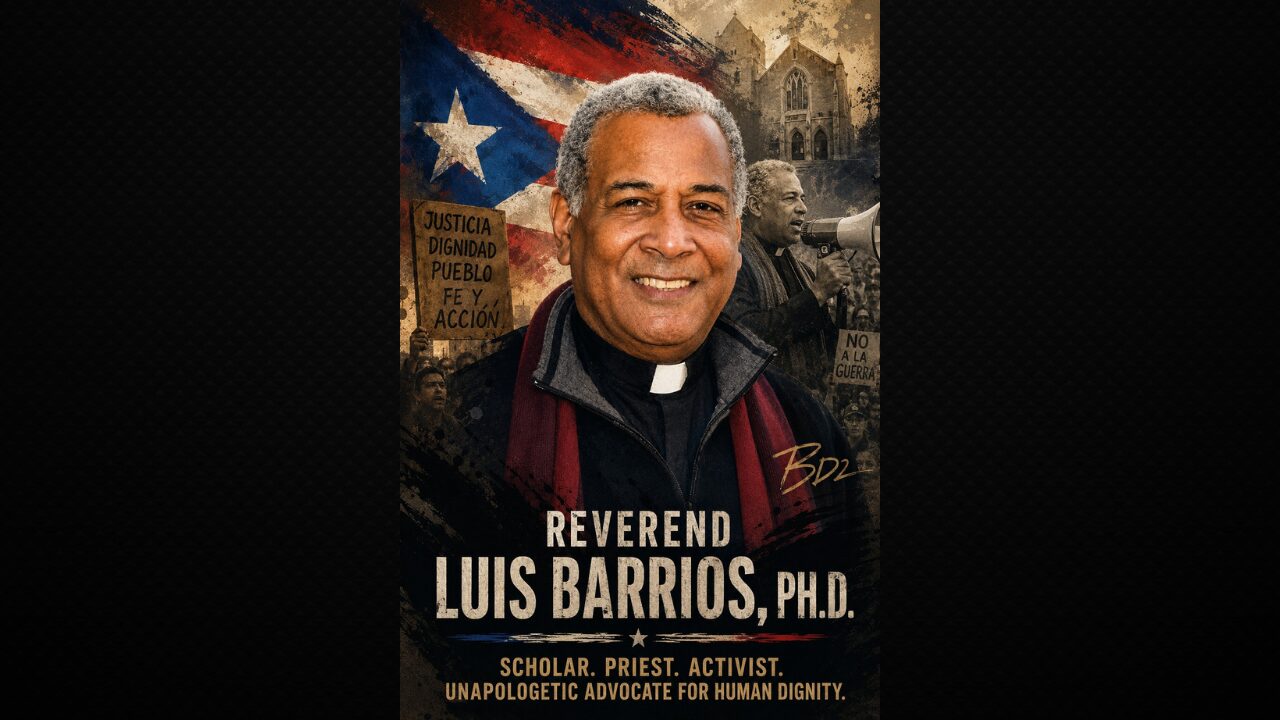
There are priests… and then there are priests who walk directly into the struggle alongside the people. Reverend Luis Barrios, Ph.D., is one of those figures. 
 A licensed psychologist, Episcopal priest, professor, activist, and community advocate, Father Barrios has spent decades combining faith, psychology, education, and Boricua consciousness into a life dedicated to defending the marginalized and uplifting communities often ignored by power. Known by many as a “revolutionary priest,” he represents a rare combination of scholar, pastor, and unapologetic advocate for human dignity.
Born in Puerto Rico and shaped by the Puerto Rican diaspora experience of New York City, Dr. Barrios earned his Ph.D. in Clinical Psychology from Carlos Albizu University and went on to become both a licensed psychologist and respected academic. At John Jay College of Criminal Justice, he teaches psychology, criminal justice, and Latin American studies while researching prison trauma, deportation, gang culture, and the psychosocial effects of displacement and poverty. 
One of the most fascinating parts of Father Barrios’ work has been his involvement studying and engaging with the Almighty Latin King and Queen Nation in New York. Rather than simply demonizing young people trapped in cycles of violence, poverty, and incarceration, he worked to better understand the deeper social, political, and psychological realities behind gang culture. He even co-authored the influential book *The Almighty Latin King and Queen Nation: Street Politics and the Transformation of a New York City Gang*, which explored how some members attempted to transform the organization toward political consciousness, community activism, and self-determination. For many in the streets, Father Barrios became someone willing to listen, guide, and challenge people toward growth instead of simply condemning them. 
But what separates Father Barrios from many public intellectuals is that he never limited his convictions to speeches or classrooms. He repeatedly put himself on the line through civil disobedience and activism, including serving jail time after protesting the School of the Americas. Whether advocating for immigrants, prisoners, Cuba solidarity efforts, or struggling communities in New York, he consistently chose action over comfort.
For many Boricuas in New York and beyond, Father Luis Barrios represents another chapter in the long tradition of Puerto Rican spiritual leaders, educators, and freedom-minded thinkers who believed faith without action means very little. His life reminds people that being Boricua is not only about culture and pride — it can also mean scholarship, courage, solidarity, healing, and standing beside humanity even when it comes with sacrifice.